Jay Ward Jay Ward
0 Course Enrolled • 0 Course CompletedBiography
Effective JN0-683 New Cram Materials & Newest JN0-683 Free Exam Questions & Excellent Juniper Data Center, Professional (JNCIP-DC)
DOWNLOAD the newest Actual4Cert JN0-683 PDF dumps from Cloud Storage for free: https://drive.google.com/open?id=1ZJc4YSzHo7Z-8kF196NYuh0esl6BBeFw
With all the questons and answers of our Juniper JN0-683 study materials, your success is guaranteed. Moreover, we have Demos as freebies. The free demos give you a prove-evident and educated guess about the content of our Data Center, Professional (JNCIP-DC) JN0-683 Practice Questions. As long as you make up your mind on this JN0-683 exam, you can realize their profession is unquestionable.
Juniper JN0-683 Exam Syllabus Topics:
| Topic | Details |
|---|---|
| Topic 1 |
|
| Topic 2 |
|
| Topic 3 |
|
| Topic 4 |
|
| Topic 5 |
|
>> JN0-683 New Cram Materials <<
JN0-683 Free Exam Questions, Reliable JN0-683 Dumps Book
Constant improvements are the inner requirement for one person. You should constantly update your stocks of knowledge and practical skills. So you should attend the certificate exams such as the test JN0-683 certification to improve yourself and buying our JN0-683 latest exam file is your optimal choice. Our JN0-683 Exam Questions combine the real exam's needs and the practicability of the knowledge. The benefits after you pass the test JN0-683 certification are enormous and you can improve your social position and increase your wage.
Juniper Data Center, Professional (JNCIP-DC) Sample Questions (Q63-Q68):
NEW QUESTION # 63
You are implementing VXLAN broadcast domains in your data center environment. Which two statements are correct in this scenario? (Choose two.)
- A. Layer 2 frames are encapsulated by the source VTEP.
- B. The VNI is a 16-bit value and can range from 0 through 16.777.215.
- C. A VXLAN packet does not contain a VLAN ID.
- D. The VNI must match the VLAN tag to ensure that the remote VTEP can decapsulate VXLAN packets.
Answer: A,C
Explanation:
* VXLAN Overview:
* VXLAN (Virtual Extensible LAN) is a network virtualization technology that encapsulates Layer
2 Ethernet frames into Layer 3 UDP packets for transmission over an IP network. It allows the creation of Layer 2 overlay networks across a Layer 3 infrastructure.
* Understanding VXLAN Components:
* VTEP (VXLAN Tunnel Endpoint):A VTEP is responsible for encapsulating and decapsulating Ethernet frames into and from VXLAN packets.
* VNI (VXLAN Network Identifier):A 24-bit identifier used to distinguish different VXLAN segments, allowing for up to 16 million unique segments.
* Correct Statements:
* C. Layer 2 frames are encapsulated by the source VTEP:This is correct. In a VXLAN deployment, the source VTEP encapsulates the original Layer 2 Ethernet frame into a VXLAN packet before transmitting it over the IP network to the destination VTEP, which then decapsulates it.
* A. A VXLAN packet does not contain a VLAN ID:This is correct. The VXLAN header does not carry the original VLAN ID; instead, it uses the VNI to identify the network segment. The VLAN ID is local to the switch and does not traverse the VXLAN tunnel.
* Incorrect Statements:
* B. The VNI must match the VLAN tag to ensure that the remote VTEP can decapsulate VXLAN packets:This is incorrect. The VNI is independent of the VLAN tag, and the VLAN ID does not need to match the VNI. The VNI is what the remote VTEP uses to identify the correct VXLAN segment.
* D. The VNI is a 16-bit value and can range from 0 through 16,777,215:This is incorrect because the VNI is a 24-bit value, allowing for a range of 0 to 16,777,215.
Data Center References:
* VXLAN technology is critical for modern data centers as it enables scalability and efficient segmentation without the constraints of traditional VLAN limits.
NEW QUESTION # 64
Exhibit.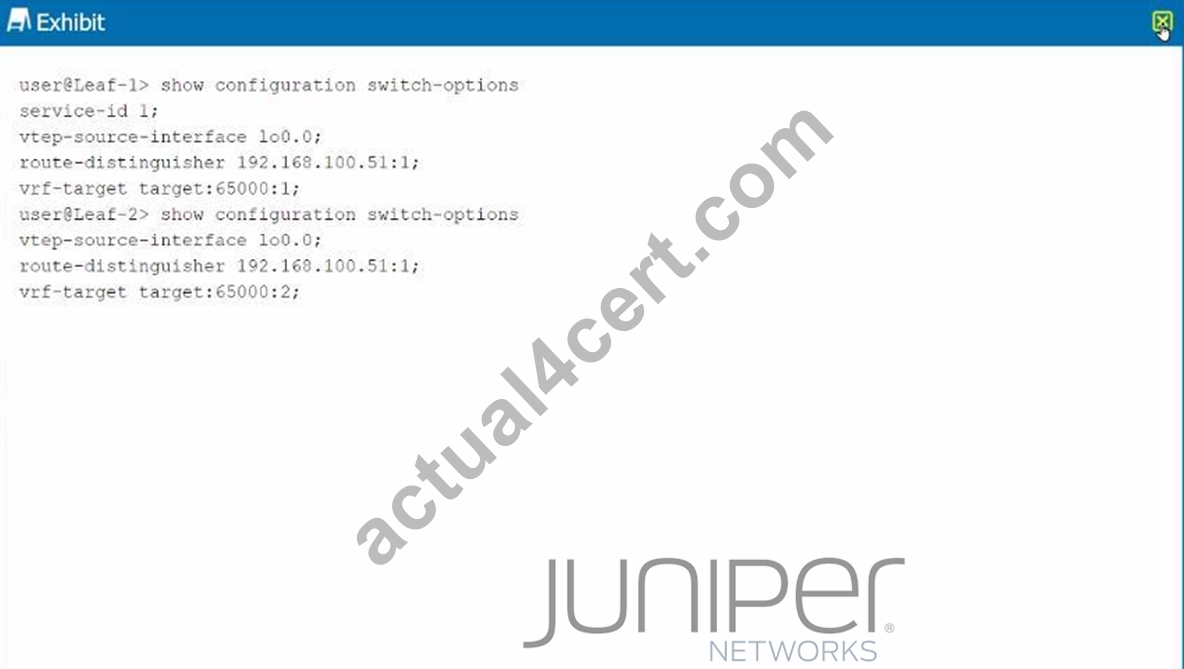
Connections between hosts connected to Leaf-1 and Leaf-2 are not working correctly.
- A. Referring to the exhibit, which two configuration changes are required to solve the problem? (Choose two.)
- B. Configure the set switch-options vrf-target target:65000:l parameteron Leaf-2.
- C. Configure the setswitch-options vtep-source-interface irb.0parameter on Leaf-1.
- D. Configure the setswitch-options service-id 1 parameter on Leaf-2.
- E. Configure the setswitch-options route-distinguisher i92.168.100.50:i parameter on Leaf-1.
Answer: B,D
Explanation:
* Issue Analysis:
* The problem in the exhibit suggests a mismatch in configuration parameters between Leaf-1 and Leaf-2, leading to communication issues between hosts connected to these leaf devices.
* Configuration Mismatches:
* Service-ID:Leaf-1 has service-id 1 configured, while Leaf-2 does not have this parameter. For consistency and proper operation, the service-id should be the same across both leaf devices.
* VRF Target:Leaf-1 is configured with vrf-target target:65000:1, while Leaf-2 is configured with vrf-target target:65000:2. To allow proper VRF import/export between the two leafs, these should match.
* Corrective Actions:
* C. Configure the set switch-options vrf-target target:65000:1 parameter on Leaf-2:This aligns the VRF targets between the two leaf devices, ensuring they can correctly import and export routes.
* E. Configure the set switch-options service-id 1 parameter on Leaf-2:This ensures that both Leaf-1 and Leaf-2 use the same service ID, which is necessary for consistency in the EVPN- VXLAN setup.
Data Center References:
* Correct configuration of VRF targets and service IDs is critical in EVPN-VXLAN setups to ensure that routes and services are correctly shared and recognized between different devices in the network fabric.
NEW QUESTION # 65
You are using E8GP peering in an underlay IP fabric. Which two statements are correct in this scenario?
(Choose two.)
- A. Every leaf node has one peering session to every spine node.
- B. Every leaf node has a peering session to every other leaf node.
- C. EBGP peering does not require an IGP protocol tor adjacency establishment.
- D. EBGP peering requires an IGP protocol tor adjacency establishment.
Answer: A,C
Explanation:
* Understanding EBGP in an IP Fabric:
* EBGP (External Border Gateway Protocol) is commonly used in IP fabrics to establish peering between routers, such as leaf and spine nodes, without relying on an Interior Gateway Protocol (IGP) like OSPF or IS-IS.
* IGP Requirement for EBGP:
* Option B:EBGP peering does not require an IGP for adjacency establishment. This is because EBGP peers are typically directly connected, and BGP establishes its own sessions without needing an underlying IGP.
* Leaf-to-Spine Peering:
* Option C:In a typical IP fabric, each leaf node establishes an EBGP session with every spine node. This ensures full connectivity between leaves and spines, facilitating efficient routing and forwarding within the fabric.
Conclusion:
* Option B:Correct-EBGP does not require an IGP for establishing peering sessions.
* Option C:Correct-Each leaf node peers with every spine node, which is a standard practice in IP fabrics to ensure connectivity and redundancy.
NEW QUESTION # 66
You are implementing seamless stitching between two data centers and have a proposedconfiguration for a border leafdevice.
In this scenario, which two statements are correct? {Choose two.)
- A. The ESI must match in both data centers.
- B. The translation-vni must match in both data centers.
- C. The ESI must be different in each data center.
- D. The translation-vni must be different in each data center.
Answer: A,D
Explanation:
* Understanding Seamless Stitching:
* Seamless stitching is used in EVPN to interconnect two data centers, allowing for consistent Layer 2 and Layer 3 connectivity across them. This is often achieved by translating VNIs (Virtual Network Identifiers) between the data centers.
* Translation-VNI:
* Option B:The translation VNI must be different in each data center to ensure that traffic can be correctly routed and distinguished as it crosses between the data centers. This differentiation helps to maintain the integrity of the traffic flows and prevents any potential overlap or conflict in VNIs.
* Ethernet Segment Identifier (ESI):
* Option D:The ESI must match in both data centers to ensure that the same Ethernet segment (which could be multihomed) is recognized consistently across the data centers. Matching ESIs are crucial for maintaining a unified view of the Ethernet segment across the interconnected fabric.
Conclusion:
* Option B:Correct-Translation VNIs must be unique to each data center for proper traffic distinction.
* Option D:Correct-Matching ESIs are necessary to maintain consistent Ethernet segment identification across both data centers.
NEW QUESTION # 67
Which two statements are correct about an IP fabric? (Choose two.)
- A. FBGP is only required to route mostrouting information to external devices outside the fabric.
- B. All leaf devices can use the same AS number in an IP fabric without making any adjustments to the EBGP configuration
- C. Only a single point to point EBGP session is required between peers in an IP fabric.
- D. The multipath multiple-as statement is required to enable ECMP if every device has a different AS number.
Answer: B,D
Explanation:
* BGP in IP Fabric:
* In an IP fabric, Border Gateway Protocol (BGP) is used to manage the routing between leaf and spine devices. Each device can have the same or different Autonomous System (AS) numbers depending on the network design.
* Multipath Multiple-AS:
* Option B:If every device in the fabric has a different AS number, then enabling Equal-Cost Multi-Path (ECMP) routing requires the multipath multiple-as statement. This configuration allows BGP to consider multiple paths across different AS numbers as equal cost, enabling efficient load balancing across the network.
* Same AS Number Configuration:
* Option A:It's possible for all leaf devices to use the same AS number in an IP fabric, which simplifies the configuration. EBGP (External BGP) will still function correctly in this setup because BGP considers the peering relationship rather than strictly enforcing different AS numbers in this specific use case.
Conclusion:
* Option B:Correct-This statement is essential for enabling ECMP in a multi-AS environment.
* Option A:Correct-Leaf devices can share the same AS number without needing special EBGP configuration.
NEW QUESTION # 68
......
Our Actual4Cert JN0-683 certification exam information is suitable for all IT certification JN0-683 exam. Its usability is fit for various fields of IT. Actual4Cert's JN0-683 exam certification training materials is worked out by senior IT specialist team through their own exploration and continuous practice. Its authority is undoubtdul. If there is any quality problem of JN0-683 Exam Dumps and answers you buy or you fail JN0-683 certification exam, we will give full refund unconditionally
JN0-683 Free Exam Questions: https://www.actual4cert.com/JN0-683-real-questions.html
- Unparalleled Juniper JN0-683 New Cram Materials Are Leading Materials - Trustworthy JN0-683: Data Center, Professional (JNCIP-DC) 🔌 Go to website ➠ www.lead1pass.com 🠰 open and search for ➡ JN0-683 ️⬅️ to download for free 🎫JN0-683 Reliable Test Materials
- Unparalleled Juniper JN0-683 New Cram Materials Are Leading Materials - Trustworthy JN0-683: Data Center, Professional (JNCIP-DC) 🥿 Search for ▷ JN0-683 ◁ on “ www.pdfvce.com ” immediately to obtain a free download 🎍JN0-683 Reliable Test Camp
- Certification JN0-683 Questions 👘 Exam JN0-683 Collection 🪁 Certification JN0-683 Questions 💉 ▛ www.pass4leader.com ▟ is best website to obtain ✔ JN0-683 ️✔️ for free download 📹Latest JN0-683 Training
- JN0-683 exam guide - JN0-683 Real dumps - JN0-683 free file 🙄 Open website 「 www.pdfvce.com 」 and search for ▷ JN0-683 ◁ for free download 🛰JN0-683 Valid Practice Materials
- 2025 Juniper Realistic JN0-683 New Cram Materials 🏺 Easily obtain ▷ JN0-683 ◁ for free download through ➤ www.pass4leader.com ⮘ ❕Exam JN0-683 Collection
- Juniper JN0-683 Troytec - accurate JN0-683 Dumps collection 🎉 Open 《 www.pdfvce.com 》 and search for [ JN0-683 ] to download exam materials for free 🤓Actual JN0-683 Tests
- Juniper JN0-683 Exam Practice Test Questions Available In Three User-Friendly Formats 😦 Go to website ⇛ www.prep4away.com ⇚ open and search for ➠ JN0-683 🠰 to download for free 😪New Exam JN0-683 Braindumps
- JN0-683 Valid Exam Pass4sure 📮 Composite Test JN0-683 Price 💙 JN0-683 Valuable Feedback 🚦 Open website 「 www.pdfvce.com 」 and search for ➡ JN0-683 ️⬅️ for free download 💆JN0-683 Dump File
- Composite Test JN0-683 Price 🎅 JN0-683 Valid Exam Pass4sure ❤️ Exam JN0-683 Collection 😨 Easily obtain ( JN0-683 ) for free download through ➠ www.real4dumps.com 🠰 🥬Test JN0-683 Practice
- JN0-683 exam guide - JN0-683 Real dumps - JN0-683 free file 🌶 Open ( www.pdfvce.com ) enter ➽ JN0-683 🢪 and obtain a free download 🥍JN0-683 Reliable Test Camp
- JN0-683 Valid Practice Materials 🐐 JN0-683 Test Dumps Free 🚅 JN0-683 Valid Exam Pass4sure ☢ Enter ▛ www.passcollection.com ▟ and search for 「 JN0-683 」 to download for free 🐇JN0-683 Valid Exam Tips
- JN0-683 Exam Questions
- nattycoach.com massageben.com primeeducationcentre.co.in pathshala.thedesignworld.in lms.coder-edge.com deaflearn.org abigail580.answerblogs.com rochiyoga.com setforthnigeria.org academy.quantalgos.in
2025 Latest Actual4Cert JN0-683 PDF Dumps and JN0-683 Exam Engine Free Share: https://drive.google.com/open?id=1ZJc4YSzHo7Z-8kF196NYuh0esl6BBeFw
